MMP13 binding
a collagen triple helix
Cartilage doesn'twear out.An enzyme eats it.
MMP13 is the enzyme that breaks down type II collagen, the scaffold that holds cartilage together. Collagen it takes doesn't grow back. MMP13 Cartilage Technology™ is built around ingredients studied for keeping it in check.
Estimated half-life of cartilage collagen. Skin's is 15.Verzijl et al. · J Biol Chem 2000
How much faster MMP13 breaks down type II collagen than MMP-1.Mitchell et al. · J Clin Invest 1996
MMP13 first found at work in human cartilage cells.Mitchell · Reboul et al. · J Clin Invest 1996
Cartilage is built to last a lifetime. MMP13 is the reason it often doesn't.
Collagen is the scaffold
Cartilage owes its strength to a mesh of type II collagen fibres. The cells inside keep it, but they can't easily replace it.
It barely renews
Cartilage collagen turns over so slowly that its half-life is put at 117 years. What's lost stays lost, which is why losing it is considered irreversible.
Verzijl 2000 · Li 2011MMP13 goes after it
Of the enzymes that cut collagen, MMP13 has the highest activity against type II collagen. It broke it down at least ten times faster than MMP-1.
Mitchell 1996 · Li 2011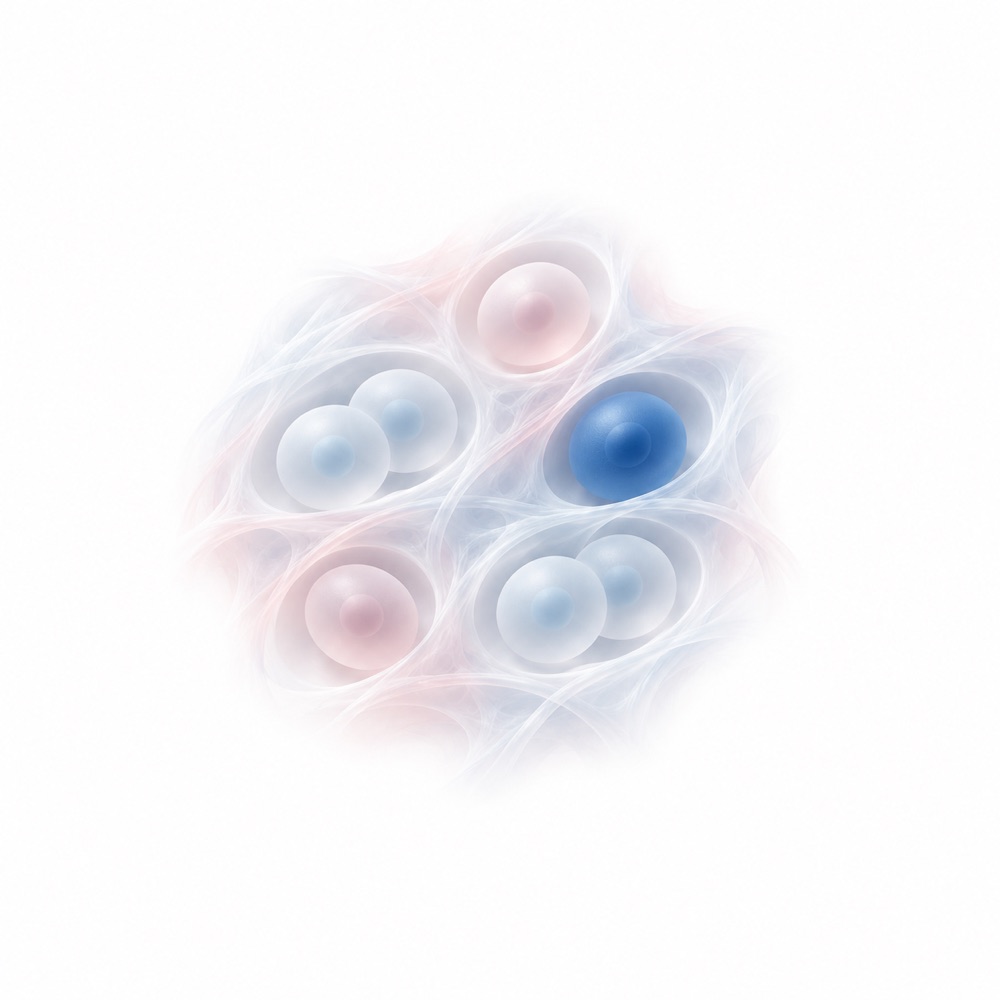
A healthy joint keeps MMP13 quiet. Here's what wakes it up.
Age on its own doesn't do it: in healthy cartilage the collagen-cutting enzymes stay level from youth to old age. What age changes is how hard the cells react when something provokes them.
Older cells over-react
Cartilage cells from older donors made significantly more MMP13 when provoked than cells from younger donors.
Forsyth 2005 · Aurich 2002Inflammation and crystals
Inflammatory signals, oxidative stress and calcium crystals all pushed human cartilage cells to make more MMP13.
Rong 2019 · Rong 2019Sugar and leptin
Higher glucose, and leptin at the levels seen with metabolic syndrome, raised MMP13 output from cartilage cells.
Jain 2024 · Primrose 2023half-life of cartilage collagen
faster than MMP-1 at breaking type II collagen
peer-reviewed studies in our library
ingredients studied for MMP13 or its sister enzymes
Feeding cartilage was never the whole job. You also have to stop what's eating it.
Dial down the enzyme
Curcumin and boswellia, the plant actives with the most MMP13 research in our library, with black pepper so the curcumin is absorbed.
Roy 2025 · Abo-Zalam 2025 · Shoba 1998Feed the matrix
Glucosamine, chondroitin and vitamin C, the building blocks cartilage cells use, each also studied against MMP13's sister enzymes.
Dodge 2003 · Hsu 2022 · Chiu 2016Look after the fluid
Hyaluronic acid, the lubricant in joint fluid, which also inhibited MMP13 in human cartilage cells, with omega-3 alongside.
Julovi 2011 · Jhun 2025"MMP13 turned over type II collagen at least 10 times faster than MMP-1."
Mitchell PG et al. Cloning, expression, and type II collagenolytic activity of matrix metalloproteinase-13 from human osteoarthritic cartilage. J Clin Invest 1996. PMID 8609233
30 studies, each one cited and labelled for what it can and can't tell you.
Open the study libraryPlacebo-controlled trial of an AKBA-rich boswellia extract: better knee function, MRI cartilage volume and thickness up, and collagen breakdown markers down.
Kumar B et al. · J Am Nutr Assoc
Human cells · 2005Cartilage cells from older donors made significantly more MMP13 when provoked than cells from younger donors.
Forsyth CB et al. · J Gerontol A Biol Sci Med Sci
Lab · 2025A curcumin compound bound and blocked MMP13, protected cartilage samples, and outperformed a dedicated MMP13-blocking drug in rats.
Roy HS et al. · Arch Pharm Res
Start with the enzyme.
What MMP13 is, what it does to cartilage and why it became the target.